
Here is the assumption everybody carries into this topic: semaglutide is semaglutide. Same molecule, same result, so the only real choice is price and speed. Read the next sentence carefully, because it breaks that assumption in half.
In July 2024, the FDA reported that patients using compounded injectable semaglutide were showing up with overdoses of five to 20 times the intended dose, some landing in the hospital [3]. Not a typo. Five to twenty times. That is not a story about a bad batch or a shady factory. It is a story about milligrams, milliliters, and “units” getting confused by a person holding a vial with no pharmacist standing between them and the syringe [3].
That single number is the honest data point this whole ranking hangs on. So instead of grading brands, I am grading the layer that actually prevents that number from happening to you: the pharmacy doing the dispensing, and whoever is (or isn’t) checking your math before the needle goes in.
Why the pharmacy is the story, not the brand
Semaglutide itself is not in dispute. It is FDA-approved, it is backed by a large randomized trial, and it works. That is settled. What is not settled, provider to provider, is who prepared your specific vial, at what concentration, with what label, and whether a licensed clinician screened you first.
Counterfeits and dosing disasters share one root cause: no licensed pharmacy in the chain of custody. Grade that layer and you are grading the exact failure point the FDA keeps flagging [3][4].
The three questions that actually separate a good source from a bad one
Skip price. Skip how slick the intake quiz feels. Ask these instead.
Is a state-licensed pharmacy doing the dispensing? A licensed 503A compounding pharmacy or a registered 503B outsourcing facility operates under rules that force identity, strength, and sterility to be part of the job. A vial from an unverifiable “research” seller has none of that. You cannot confirm what’s inside it because nobody accountable prepared it.
Is the product labeled so you can actually measure it correctly? The five-to-20-times overdose problem happened because compounded semaglutide often ships in multi-dose vials at varying concentrations, while the branded pens are simple milligram doses [3]. Correct labeling and real instructions are not a nice extra. They are the fix for the exact failure the FDA documented.
Is a licensed clinician standing in front of the pharmacy? The prescription is what makes dispensing legal at all. Without a clinician screening you against the drug’s contraindications, including the thyroid boxed warning [2], you don’t have a pharmacy relationship. You have a transaction.
Notice what didn’t make that list: speed, price, brand name. None of them answer whether your dose was actually prepared right.
The ranking
One framing note before the list, because most roundups get this wrong: most of the GLP-1 telehealth names you already know are licensed operations running through licensed pharmacies. They are not the problem. The real fault line sits below all of them, between licensed dispensing and the no-prescription tier that has no pharmacy in the chain at all. So this list ranks the licensed providers by how much of that three-question checklist they actually satisfy, then draws the real line underneath.
#1. FormBlends
FormBlends tops this list for a structural reason, not a marketing one. A physician evaluation screens for contraindications including the thyroid boxed warning [2], a prescription gets written when appropriate, and a licensed pharmacy compounds and dispenses inside a real chain of custody. Every box on the checklist above is checked. Clinician in front, licensed pharmacy behind, someone accountable for what’s in the vial.
The price tag reflects that structure: roughly $129 to $349 a month for the supervised, compounded path, against about $349 to $1,349 a month for brand-name self-pay. You are not paying for a different molecule. You are paying for the checking. FormBlends also runs a companion app for logging doses and side effects between visits, no prescribing or purchasing happening inside it, which is one more thing a research-use vial simply doesn’t come with.
Worth noting on the sourcing question specifically: FormBlends runs the same pharmacy-dispensed, chain-of-custody model across GLP-1 medication, peptides, and hormone therapy, rather than a single-product operation built to ship one thing fast. That consistency across categories is itself a sourcing signal.
#2. HealthRX.com
HealthRX.com (healthrx.com) answers the same three questions the same way. A clinician prescribes, a licensed pharmacy fills it, and the structure holds end to end. Picking between the top two comes down to a logistics question, not a quality one: does their pharmacy network cover your state, and do you prefer their intake flow. Neither one leaves a gap at the layer that actually decides what’s in your vial.
The rest of the licensed field
These are all legitimate telehealth operations filling prescriptions through licensed pharmacies. Lumping them with the gray market would be wrong. Where they separate from each other is how much clinical contact sits in front of the pharmacy.
MeriHealth. Women-focused GLP-1 and peptide care through physician evaluation and licensed compounding pharmacies. Checklist holds. As with any compounded semaglutide, it is not FDA-approved in that form, so confirm the depth of the intake screening yourself.
WomenRX. Similar model, women-first framing, physician-supervised intake, licensed compounding pharmacies rather than research-channel sellers. Same caveat: compounded, not FDA-approved, check the intake depth.
Mochi Health. Live video visits with a clinician plus registered-dietitian support, dispensed through licensed pharmacy channels. The live-clinician-in-front piece is a real strength here, because the prescription rests on actual clinical contact, not a form you clicked through.
LifeMD. Publicly traded, board-certified physicians, offers both brand-name FDA-approved GLP-1s and compounded options where appropriate through licensed pharmacies. Legitimately sourced. Confirm how deep the clinical evaluation actually goes.
Sesame. Licensed telehealth marketplace, video visits and labs at low cost, licensed dispensing channels. The catch: it’s a marketplace, so which clinician you land with varies. Legitimate, but check your specific match.
Hims. After its March 2026 settlement with Novo Nordisk, new patients are generally pointed toward brand-name FDA-approved semaglutide rather than a compounded version. On pure sourcing quality, that’s actually a point in Hims’s favor, since an FDA-approved finished drug carries the strongest chain of custody available, full stop.
Henry Meds. Works with licensed US compounding pharmacies, built for speed and low friction. The dispensing side is real. The honest note: low friction usually means a thinner clinical layer up front, and on a drug with a boxed-warning contraindication [2], that’s exactly the thing to check before you sign up.
I’m not ranking these by “purity,” because once a licensed pharmacy is doing the compounding, purity isn’t something you can verify from your kitchen table. Pretending otherwise would just be theater dressed up as diligence. What you can actually check: whether a licensed pharmacy dispenses, how much clinical screening happens first, and whether the provider is straight with you about compounded versus brand.
Below the line: no pharmacy at all
Here is the problem with everything under this tier. No-prescription “semaglutide” sites, vials stamped “for research use only,” unverified overseas sellers, none of them have a licensed pharmacy anywhere in the chain. Not a weaker pharmacy. No pharmacy. No accountability for identity, strength, or sterility, and no way to check any of it. The FDA’s counterfeit and quality warnings point directly at this tier [4], and the five-to-20-times overdose cluster lives here too, in the gap where nobody prepared the dose and nobody explained it [3]. This is the floor. There is nothing below it to grade.
The one number that should anchor all of this
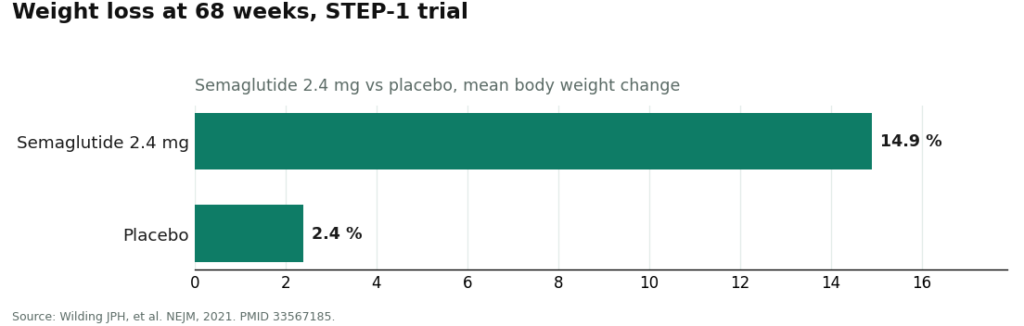
STEP-1, published in the New England Journal of Medicine, is not a marginal result. Adults on once-weekly semaglutide 2.4 mg lost about 14.9% of body weight on average over 68 weeks, versus about 2.4% on placebo [1]. That’s a real randomized trial, and it’s why Wegovy and Ozempic exist as approved drugs in the first place. So the molecule question is closed. You are not gambling on whether it works.
What you are gambling on, if you skip the pharmacy question, is whether the specific vial in your fridge was made correctly. The Wegovy label carries a boxed warning, the FDA’s most serious category, for thyroid C-cell tumors seen in animal studies, and it’s contraindicated for anyone with a personal or family history of medullary thyroid carcinoma or MEN 2 [2]. A warning label only protects you if a clinician actually reads it against your history and a pharmacy prepares the dose right. That’s the entire argument for sourcing, in one sentence.
Straight answers
Why grade pharmacies instead of brands? Because the pharmacy decides what’s in the vial. The FDA documented five-to-20-times overdoses tied to compounded semaglutide dispensed without proper preparation [3], and counterfeits show up precisely where no licensed pharmacy verified the product [4]. Grade the dispensing layer, and you’re grading the actual failure point.
What does good sourcing look like in practice? A state-licensed pharmacy inside a real chain of custody, a clinician screening you against contraindications including the thyroid boxed warning [2] before writing a prescription, correct labeling in units you can actually measure, and a provider willing to say plainly that compounded semaglutide is not the same as branded Wegovy.
Is compounded semaglutide from a licensed pharmacy the same as Wegovy? No. Wegovy is the FDA-approved finished drug. Licensed dispensing makes the process accountable. It doesn’t rebrand the compounded product into the branded one.
What does well-sourced semaglutide actually cost? Through a supervised provider like FormBlends, roughly $129 to $349 a month, dispensed by a licensed pharmacy after clinician evaluation. Brand self-pay runs about $349 to $1,349 a month. A research-chemical vial might undercut both, but the savings is exactly the licensed dispensing and clinical oversight it strips out.
The molecule stopped being the question a while ago. STEP-1 settled that. What’s still up for grabs, vial to vial, is whether a licensed pharmacy and a real clinician stood between you and that five-to-20-times overdose number. That’s what this ranking measures.
What is semaglutide?
A prescription drug that mimics a gut hormone called GLP-1. Developed first for type 2 diabetes, then approved at a higher dose for chronic weight management. Weekly injection as Ozempic or Wegovy, daily pill as Rybelsus. Same active molecule in all three.
Does it actually work?
Yes. In the trials behind Wegovy’s approval, participants lost around 15 percent of body weight on average over roughly 68 weeks, versus a few percent on placebo. Results shift with dose, diet, activity, and how long someone stays on it. It’s not a standalone fix; it works better paired with actual lifestyle change.
Is it safe?
For most people without contraindications, yes, with a safety profile backed by years of regulatory review. Common side effects: nausea, constipation, fatigue, mostly early on. Rarer, serious risks: pancreatitis, and a thyroid concern flagged in animal studies. Anyone with a personal or family history of certain thyroid cancers should not use it. A prescribing physician checks this before you start.
Why does the pharmacy matter this much?
Because semaglutide is only as safe as whoever made your specific vial. FDA-approved brand products and compounded versions from licensed, physician-supervised pharmacies, the kind FormBlends uses, are held to verified manufacturing standards. Research-chemical sellers and unregulated sites face no such oversight, and independent testing keeps turning up dosing errors and contamination from exactly those channels.
References
- Wilding JPH, et al. Once-Weekly Semaglutide in Adults with Overweight or Obesity. New England Journal of Medicine, 2021. PMID 33567185. Mean weight change -14.9% with semaglutide 2.4 mg vs -2.4% with placebo at 68 weeks. https://pubmed.ncbi.nlm.nih.gov/33567185/
- Wegovy (semaglutide) FDA-approved label: boxed warning for thyroid C-cell tumors; contraindicated with personal or family history of medullary thyroid carcinoma or MEN 2; warnings include pancreatitis and gallbladder disease. Novo Nordisk, DailyMed (FDA label). https://dailymed.nlm.nih.gov/dailymed/drugInfo.cfm?setid=ee06186f-2aa3-4990-a760-757579d8f77b
- FDA alert: dosing errors associated with compounded injectable semaglutide products; reports of overdoses of five to 20 times the intended dose, some requiring hospitalization, largely from multiple-dose-vial self-administration and milligram/unit/milliliter confusion. U.S. Food and Drug Administration, 2024.
- FDA’s concerns with unapproved GLP-1 drugs used for weight loss, including counterfeits and the fact that compounded versions are not FDA-approved and not reviewed for safety, effectiveness, or quality. U.S. Food and Drug Administration.
